Free programs written for comet and asteroid observers.
JustComets
Plan the night, measure and report your comets and asteroids, and make pictures to keep and to share - in one free program.
Windows · Linux · macOS | English · Español | Freeware
JustComets is a desktop program for observers of comets and asteroids. It follows a night from start to end: which targets are worth observing and when, where each target was and how bright it was, the report for the Minor Planet Center, the finished picture, and an annotated image to share with the observation and its details. Each part is a module of its own, so you can use only the ones you need beside the programs you already have.
The whole program and its help, with the user's manual, the tutorials and the reference, is in English and Spanish. It follows the language of your system at first, and Settings changes it.
JustComets is in an early beta. It is complete enough to be used and tried, but it has not yet been proven over many nights by many observers, and it can still make mistakes. Please check its results.
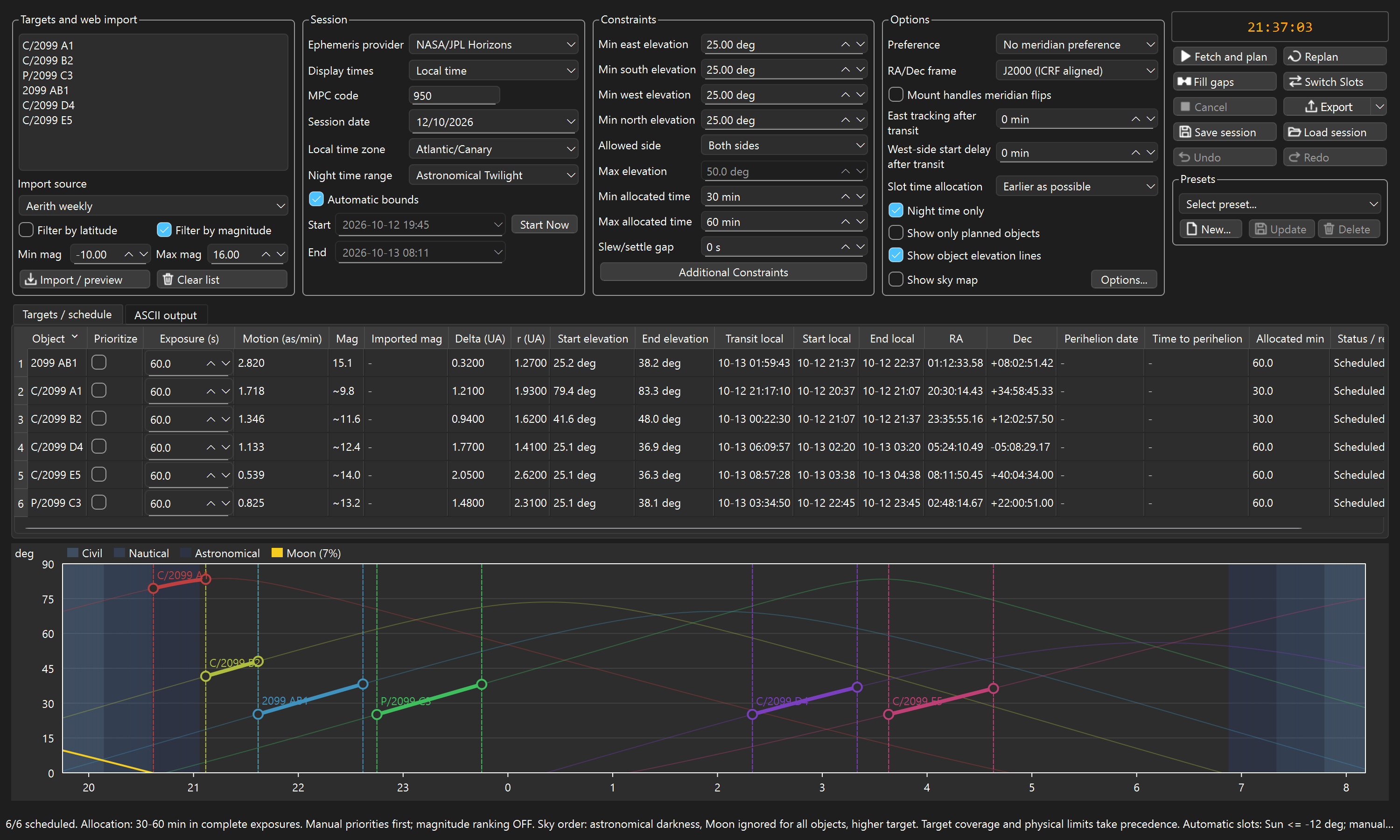
Which comets and asteroids can you observe tonight, when, and for how long? Give the planner your site, the night and a list of targets: it fetches their positions from the Minor Planet Center or JPL Horizons, works out when each one is high enough, the sky dark enough and the mount on the right side of the meridian, and fits one observing block per target into the night.
Targets typed by designation or name, or picked from lists: comets of the week, the MPC's possible comets, the newest comets, catalogs of asteroids and comets filtered by magnitude.
Your horizon in four directions, twilight, the Moon, block lengths, the meridian rules of your mount.
A graph of the night with every target's elevation, and blocks you can move, swap and fill by hand.
Exports for N.I.N.A., KStars/Ekos (StellarMate), CCDCommander and the ZWO ASIAIR, ready to run.
Astrometry and Photometry
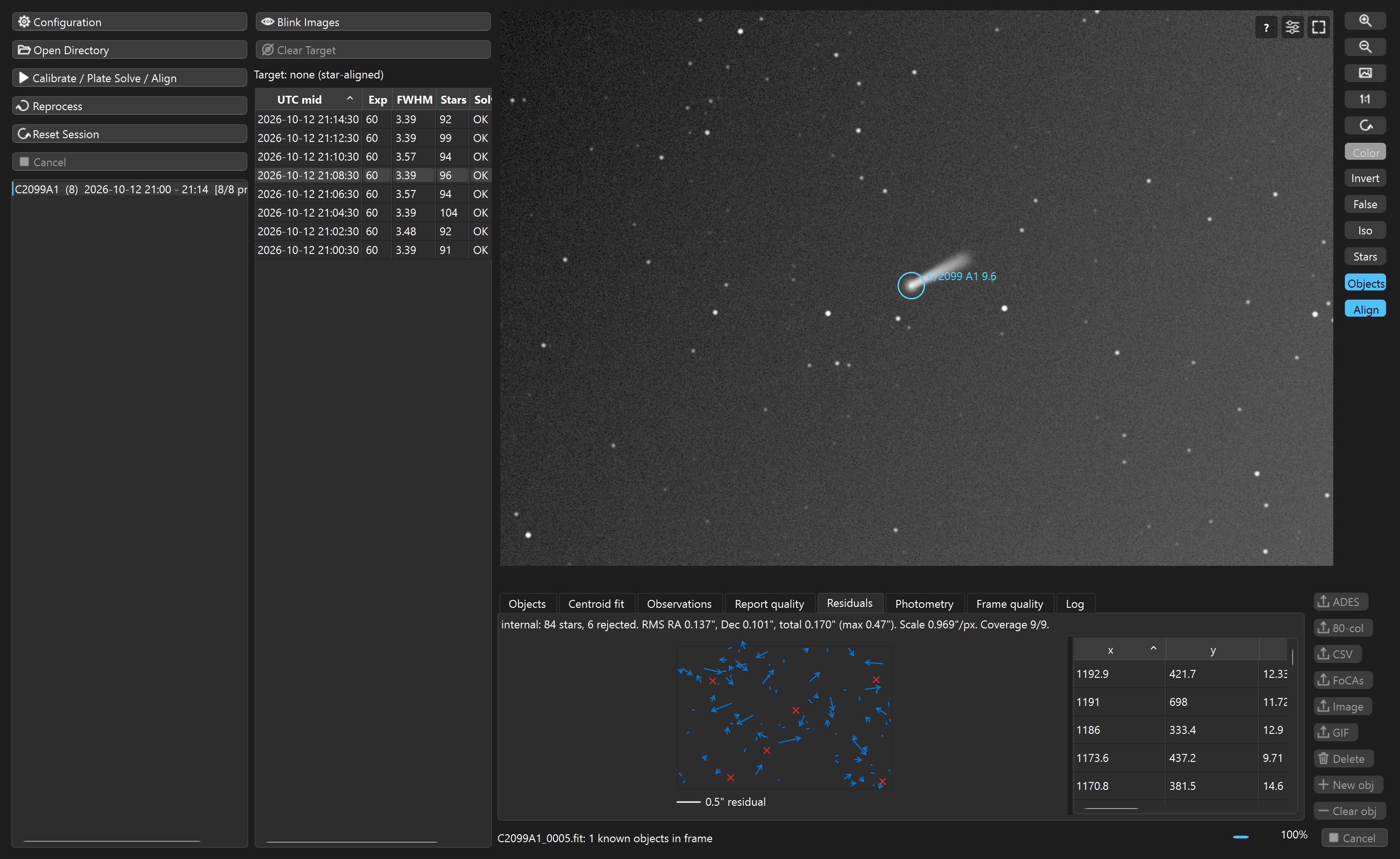
From the frames of a night to a report for the Minor Planet Center. JustComets calibrates the frames, plate-solves each one against the Gaia catalog, finds the known comets and asteroids in them, and lets you measure the target with a double click - in single frames or in stacks that follow its motion.
Plate solving with its own solver against Gaia (online, or offline from catalog files), or with ASTAP.
Positions and magnitudes measured together, with the quality of the report graded before you send it.
Comet photometry in the way of FoCAs (Cometas_Obs), ADES and 80-column reports, and sending to the MPC after your confirmation.
Your positions compared with those of other stations, and annotated images and animated GIFs of the night.
Image Annotation
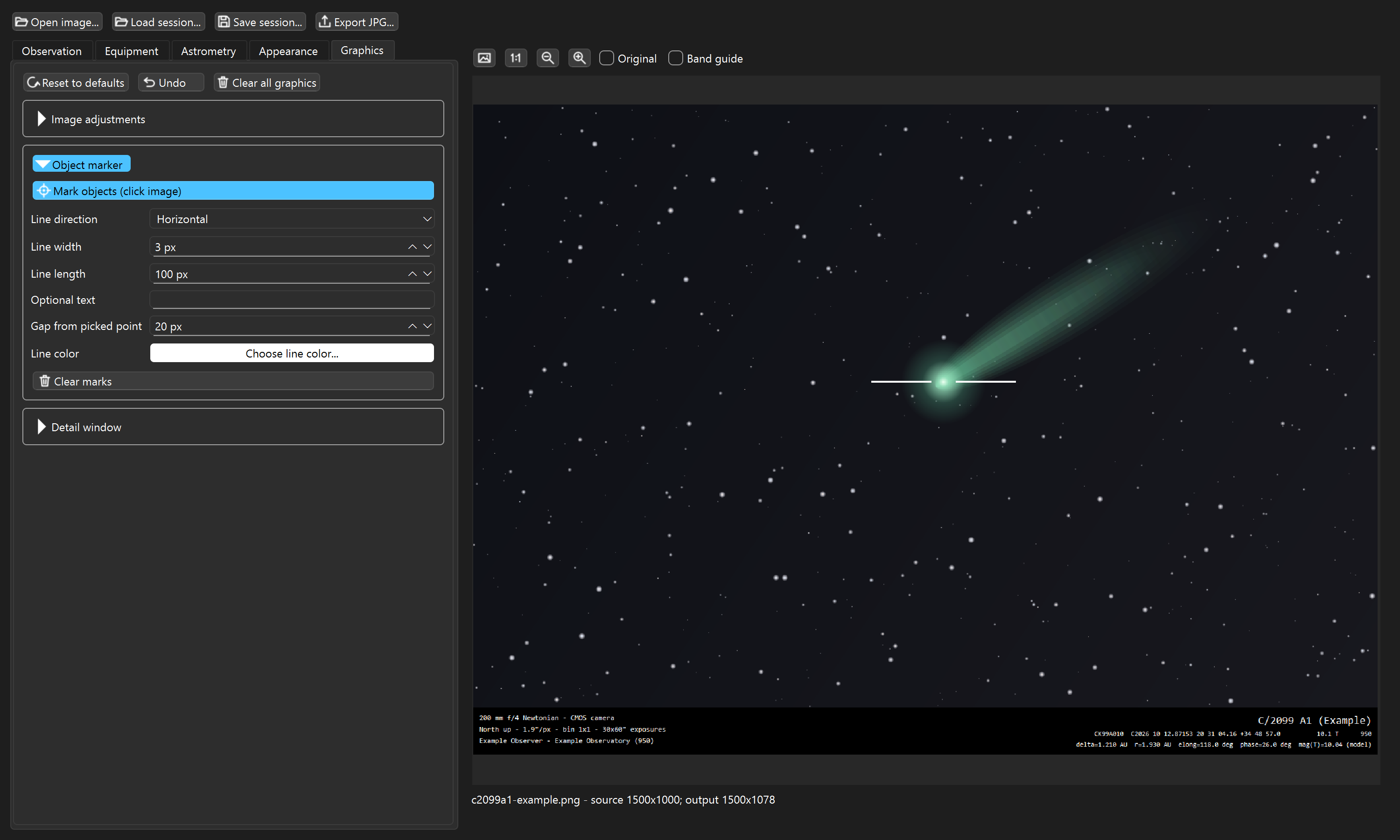
A comet picture ready to share: a band under the image with the object's full name, your equipment, the exact observation from your MPC report and the observing geometry - and marks that point at the object and enlarged details of its coma.
The observation taken from your MPC report (from Astrometry and Photometry or any other program), the full name and the distances, elongation, phase and magnitude of the night fetched online - or typed by hand.
Your telescope, camera and site in the band, kept as presets for each setup.
Marks on the object, and enlarged details in a corner, also in false color or with isophotes to show a coma's shape.
A JPG named from the observation (c2099a1-20261012-950.jpg); the picture you opened is never changed.
Image Processing
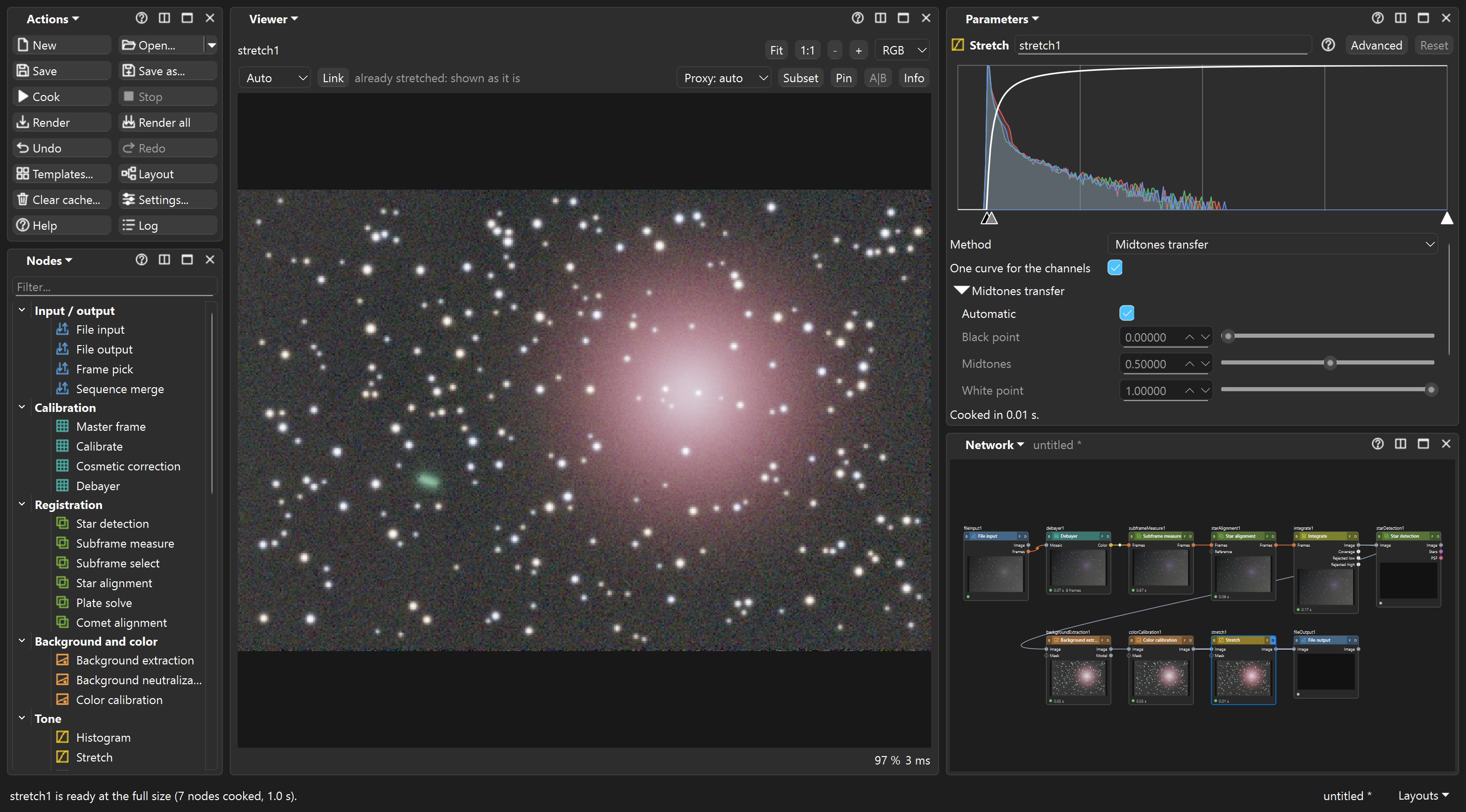
From the frames of a night to a finished picture, in a network of nodes that you link and can change at any time: the network keeps the recipe, not only the result, and no file you read is ever changed.
Calibration, debayer, frame measurement and selection, alignment on the stars or on the comet, integration with rejection, drizzle and mosaics.
Comet integration: the comet without the stars, the stars without the comet, and both together - also when the comet moves too little for the star trails to be rejected.
Background, color calibration (also photometric, with Gaia), stretch, curves, noise reduction, deconvolution, local contrast, masks, LRGB and narrowband palettes, pixel math.
Ready-made networks for one-shot color, comets, mono LRGB and narrowband; fast on long sequences of large frames.
In every module
Help in the program: a user's manual, a reference of every control and every node, tutorials and a glossary, in English and Spanish. F1 opens the entry of whatever is under the mouse.
Your data stays yours: no account, no tracking; the internet is used only to ask public services for the data a feature needs, and much of the work goes on offline.
A dark and a light look, or the one of your system.